14 June 2006


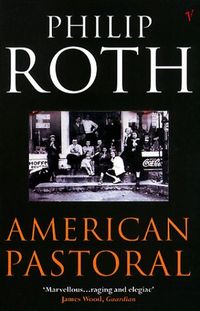
Don't read Philip Roth's American Pastoral if you hold any illusions about controlling your own destiny, entertain secret, willowy notions of living out the American Dream, or have kids. Phil will pierce your private ambitions with a deft stroke through the scrotum and keep jamming until he comes out your rectum. It's a circuitous route, but it's a desperately painful one. If Tuna wants books that capture the spirit of the times, well how about the spirit of changing times, most notably, the shift from Eisenhower's America of golden opportunities to LBJ's USA of subversion at any cost. What happens if the perfect illustration of America's special place in God's heart has a daughter who wants to tear down everything about the worldview that created his place and time and standing? It's heart-wrenching and horrifying and hilarious, and it shatters any illusion you might quietly be clinging to about shaping your children's lives. I haven't slept right for days, and I've developed an ugly twitch in my left shoulder that suggests incipient heart trouble. Yes, Phil says, no matter how decent you are or how honestly you play by the rules or how fairly you treat your fellow man, life can shit all over you with such great force that you'll swear the man upstairs has projectile diarrhea. Is the book any good, given that it has landed itself a Pulitzer and a spot in the top 5 of that recent NY Times poll of the best American novels of the last 25 years? Like Sabbath's Theater, it has sections of sustained virtuosity, and sections of repetitious tedium. I'd have cut 100 pages. That said, does anybody have more to say about the second half of the American 20th century? No, says the dude on the couch on Lawton.

Fuck Soccer, Let's Rumble

13 June 2006

Today is the first day of my holiday, and I don't know what to do with myself. I've already done the yard work, cleaned the barbecue, gone to the gym, picked up more flonase, caught part of all three World Cup games, talked Brazilian women with the cashier at the burrito joint, changed three diapers, read 70 pages in American Pastoral, listened to the Rise of Hitler in the car, and cleaned my ears. It's now 2:47 PST and I'm plum out of ideas. Two kids will be up in an hour. Suggestions?

10 June 2006

Place Your World Cup Bets...


Hup Holland!

09 June 2006


If you look over the list of Nobel Prize winners for literature, it’s amazing how many vowels you’ll find, and how few of those unpronounceable names you’ll recognize. I haven’t seen so many umlauts since the Huskers were passing out promos at the hardcore show at Fender’s in Long Beach, and I came back from that with a broken nose and a strange sense of euphoria. But I digress. Every now and again, I get a momentary inspiration to check out some of those foreign “greats,” and usually find myself waking up on the couch with the book splayed across my chest and dark spittle crusting at both sides of my mouth. Mojo usually sounds like a pretty good alternative at that point.

Not so, however, with this week’s try, Par (umlaut city!) Lagerkvist’s Barabbas, the story of the man who, allegedly, when Pilate asked the crowd of screaming Jews whom they would free, they chose instead of Christ. For some, Christian anti-Semitism is born here, as the blame for crucifixion shifts from the Romans to the Jews. It’s Mel Gibson’s favorite Christmas story. His kids get a big kick out of it. Anyway, Lagerkvist, who won the Nobel in 1951 after publishing this short novel/parable in 1950, evidently struggled with faith throughout his life and delivers this brief, imaginative post-exoneration life for the man Christians believed should have died instead of JC. Barabbas, who secretly witnesses Christ’s crucifixion at Golgotha and sees the skies turn black when he finally dies on the cross, tries and fails his whole life to truly believe. We follow him back from that scene to the bed of his fat lover, who wallows in his body and takes pleasure in his emotional apathy. We see his return to the cave of his fellow bandits, who find him so changed and so strange that they secretly plot to kill him before he disappears to their great relief. We see him enslaved and then chained to a true believer, whose childlike innocence and purity of belief torment the faithless Barabbas. And finally we see him exuberantly join in the burning of Rome, which he mistakenly believes is Christ bringing an end to the world and delivering the kingdom. In prison awaiting execution, he's offered one last chance at salvation, and the next day's crucifixion will determine his final choice.

You can read this on a number of levels, and I’m guessing that both devout Christians and godless existentialists could swing a thesis out of it. I’m also guessing that’s Lagerkvist's intent. It’s a haunting work that’s effecting in indefinable ways, so if you want something you can read in an afternoon that allows you to ponder some of the big questions without shoving them didactically down your throat, head for this dark, cobblestoned Swedish street.
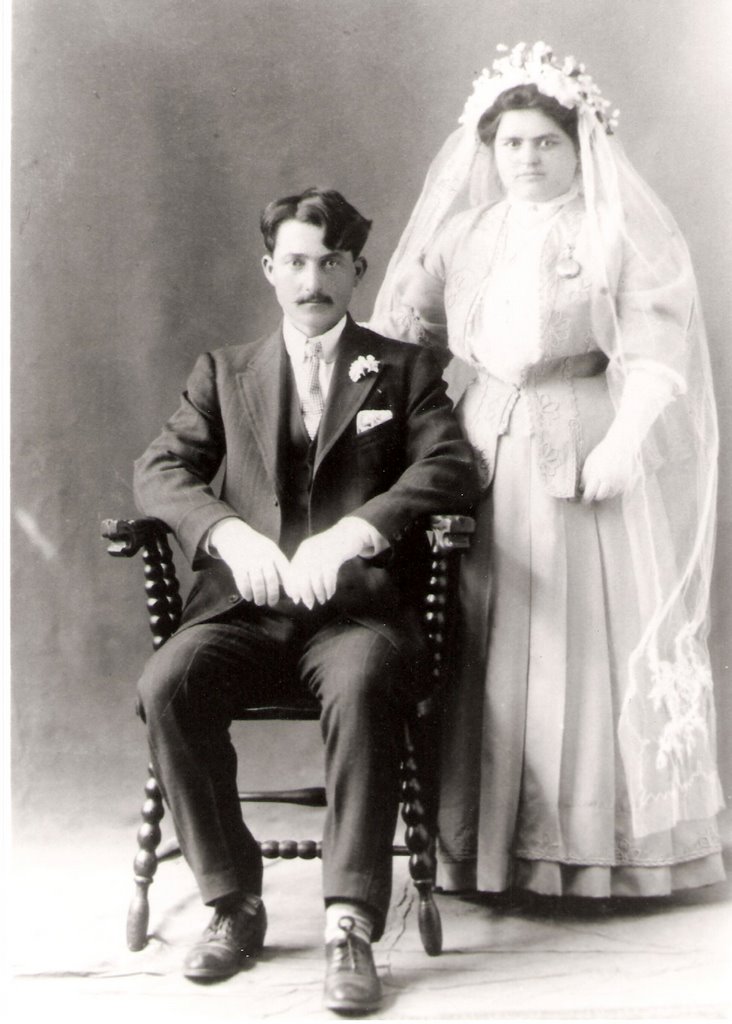
My Great Grandparents;

14 when they came over from Lucca, 22 when married (wedding pic)